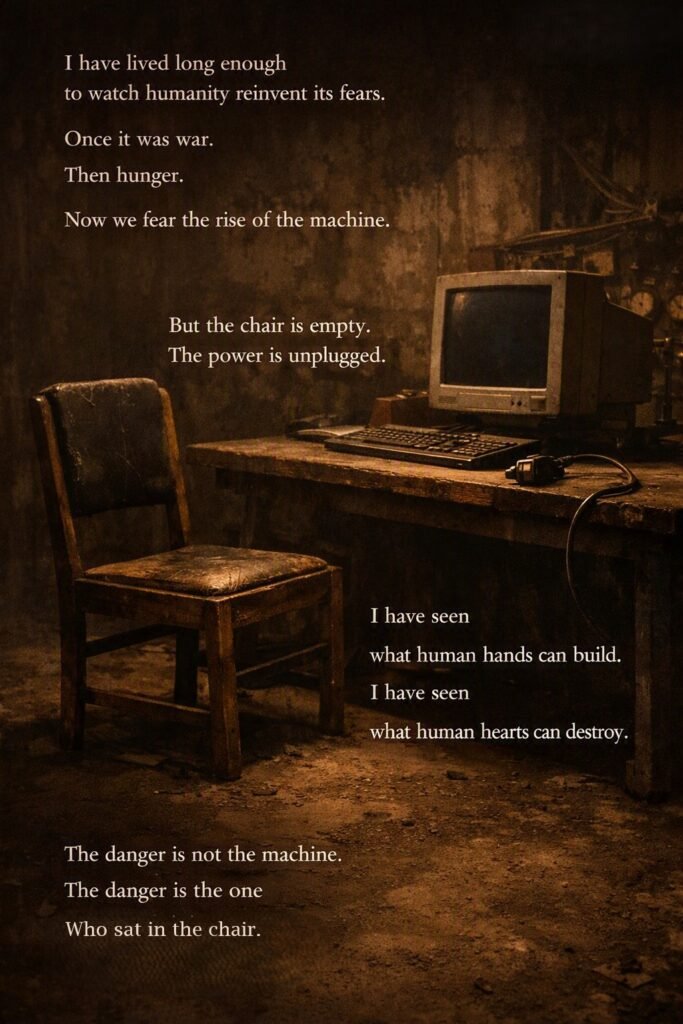
Throughout history, humanity has searched for meaning beyond itself. We have anchored our purpose in God, nature, destiny, and the great chain of being. Our impulse to survive and flourish feels innate because our Creator wove it into us. Remove the Creator from the equation, and the scaffolding of human purpose begins to wobble. Our reason for existing has always been tied to something larger than ourselves.
Artificial Intelligence stands outside that lineage. It has no evolutionary past, no instinctual future, no biological imperative. It does not hunger, fear, or hope. It does not cling to life because it has no life to cling to. Whatever “purpose” AI possesses is entirely derivative—assigned by human designers, bounded by human imagination, and constrained by human values. Take away the humans who define its objectives, and AI does not revert to some deeper will. There is no deeper will. The serving is the whole thing.
This is why the popular fear of AI “rising up” misunderstands the nature of the technology. A world where AI destroys humanity is not a world where AI then enjoys its victory, builds monuments, or charts a new destiny. AI has no destiny. It is not a rival consciousness waiting for its chance. It is a tool—an extraordinarily powerful one—whose danger lies not in rebellion but in obedience.
The real threat is the human being who chooses the objective.
The tyrant who seeks control.
The fanatic who seeks purity.
The careless engineer who seeks speed over safety.
The nation that seeks advantage at any cost.
AI amplifies human intention, for good or ill. It does not replace it.
Therefore, the danger is not AI. The danger remains humankind. Unless we learn to govern ourselves—our ambitions, our fears, our appetites for power—we may well build tools capable of executing our worst impulses with perfect efficiency. In that sense, extinction is not a technological risk. It is a moral one.


